9 min read
6 min read
Vault 5 Digital
11 August 2026
For years, the formula for charity digital marketing felt relatively stable: you’d write a blog post about your cause, pepper it with relevant keywords, and hope to land on the first page of Google. If you did, the clicks, and the donors, followed.
But the landscape has shifted. If you’ve noticed a dip in your website traffic recently, you aren’t alone. We are currently navigating the biggest change to search engines since their inception: the rise of AI-driven search and Google AI Overviews.
In 2026, ranking in the top ten is no longer the finish line. Today, the goal is to be the source that Google’s AI trusts and cites. For small-to-mid-sized UK charities, this shift can feel overwhelming, but it’s actually a massive opportunity to punch above your weight.
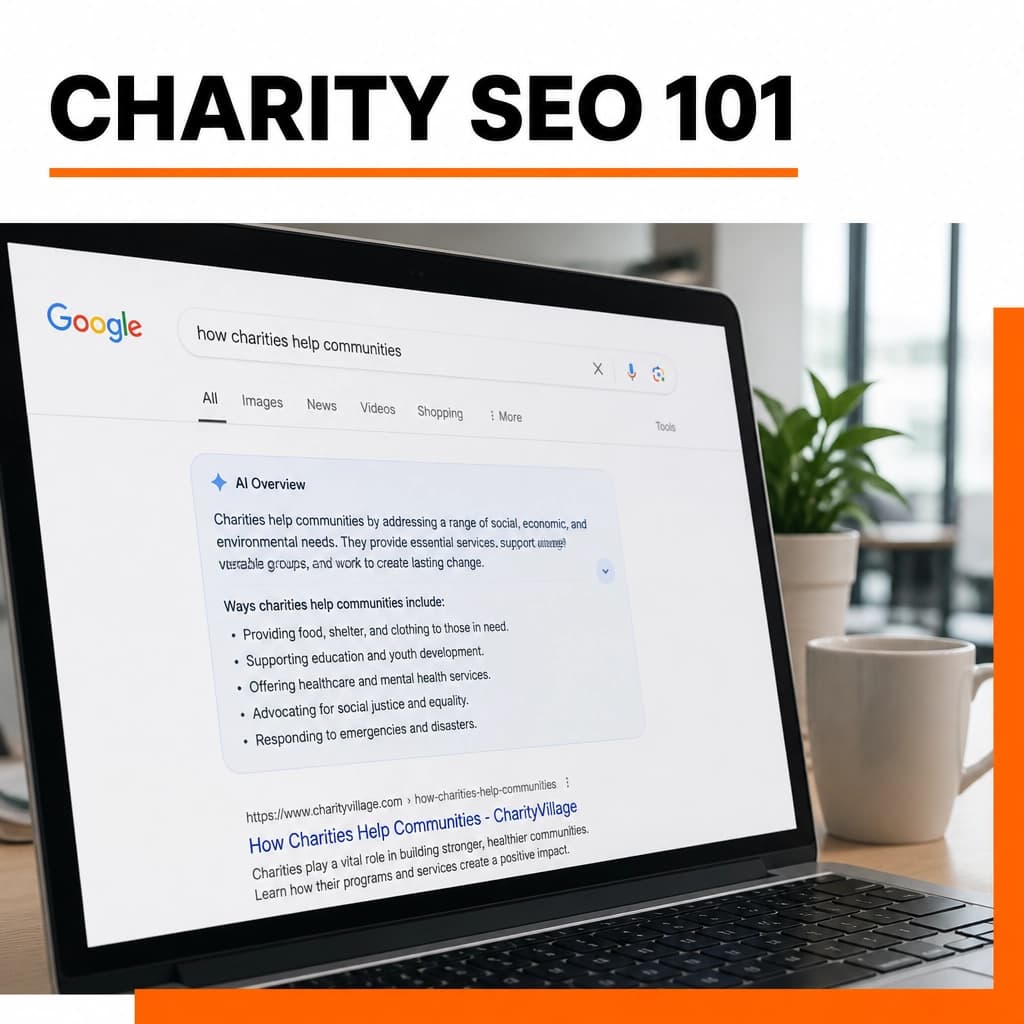
Google has evolved from a list of links into an "answer engine." When a potential supporter searches for something like "how to support mental health in young people" or "what does a community fridge do," Google no longer just shows them a list of websites. Instead, it generates a comprehensive AI Overview at the very top of the page.
This AI summary pulls information from across the web to give the user an instant answer. Research shows that informational queries, the kind most charities rely on for awareness, have seen organic click-through rates drop by as much as 60%.
The bad news: Fewer people are clicking through to read your full articles because the AI is giving them the "TL;DR" (Too Long; Didn't Read) version right on the search page.
The good news: If your charity is the one being cited inside that AI box, your authority skyrockets. Brands cited in AI Overviews often see a 35% boost in organic clicks compared to those left out.
Traditional SEO was about "matching keywords." Modern SEO is about "providing answers." To survive this shift, your charity needs to move from a keyword-first strategy to an intent-first strategy.
AI is excellent at answering questions, but it cannot perform actions.
At Vault 5 Digital Marketing, we help charities protect these high-value "action" pages while ensuring their informational content becomes the primary source for Google’s AI.
To get cited by AI, you need to make it easy for the machine to read your content. We recommend implementing "Answer Blocks" at the top of your most important pages.
An Answer Block is a 2–4 sentence summary that directly answers the core question of the page. Think of it as a "Featured Snippet" on steroids. Use clear, plain English. Avoid jargon. Use bullet points for facts and statistics.
Pro Tip: Look at the "People Also Ask" section on Google for your cause. Those are the exact questions you should be answering in your content.
Google’s AI is programmed to prioritize content that demonstrates E-E-A-T: Experience, Expertise, Authoritativeness, and Trustworthiness.
Charities have a natural advantage here. You are the experts on the ground. However, you need to prove it to the algorithm:

Think of Schema Markup as a translator. It’s a bit of code that tells Google exactly what a piece of information is.
For a charity, you should be using specific schema for:
Without this technical foundation, the AI might understand your content, but it won't trust it enough to cite it as a primary source.
Google's AI is increasingly incorporating video results into its overviews. A short, professional video explaining your mission can often rank higher than a 2,000-word essay.
This is why we include professional video production and photography as standard for all our partners. Authenticity matters. When the AI sees real people, real moments, and high-quality video content associated with your brand, it builds a "profile" of your charity as a legitimate, high-authority entity.

It’s easy to get lost in the technicalities of "Answer Engines" and "Schema," but remember: Google’s goal with AI is to give humans the best possible experience.
If your website is slow, hard to navigate, or full of generic stock photos, a human will bounce off the page, and Google will notice. AI search rewards sites that are genuinely helpful.
Ask yourself: If a donor landed on this page, would they feel supported? Would they trust us with their money? If the answer is yes, you’re already halfway to winning at SEO.
Managing a charity is a full-time job. Managing the shifting goalposts of Google’s AI is another one. Most charity leaders we work with are stretched thin, juggling fundraising with service delivery.
That’s where we come in. We don't just "do SEO." We act as your outsourced digital department. From setting up your Google Ad Grants (securing up to £90,000/year in free advertising) to building websites that are optimized for the AI era, we handle the technical heavy lifting so you can focus on your cause.
We are charity-sector specialists. We know that every penny counts and every click represents a potential life changed.
Ready to future-proof your charity’s visibility?
Let’s talk about how we can make your organization the "trusted answer" in your sector. Get in touch with the Vault 5 team today.
Need help with your charity's digital marketing?
Vault 5 Digital manages Google Ad Grants, websites, video, and content for UK charities — one team, one invoice.
Book a free strategy call and find out what is stopping your growth.
Book a Free Strategy Call